Posts mit dem Label Recherche werden angezeigt. Alle Posts anzeigen

Donnerstag, 31. März 2016

Sexy. Badass. Medieval!

Guten Abend

Verzeiht mir den reisserischen Titel, aber den konnte ich mir nicht verkneifen. Ich wollte ihn auch nicht übersetzen, weil er so einfach schmissiger rüberkommt. Jedenfalls möchte ich heute über die Recherche zu meinem neuen Mittelalterkleid schreiben, und die begann eigentlich ganz unspektakulär:Vor etwa einem Jahr bekam ich ein wunderschönes Haarnetz geschenkt. Ich begann darum nachzulesen, zu welchen Kleidern man im Mittelalter Haarnetze trug. Auch wollte ich, dass mein nächstes Mittelalterkleid hitzesommertauglicher wird als das, was ich im Moment habe.
Vor allem für das Spätmittelalter und die Renaissance findet man viele Bilder von Haarnetzen, aber meistens waren die sehr aufwändig gemacht, mit Goldreifen, Schleiern und anderem Zierrat, dabei suchte ich eher nach schlichten Exemplaren. Schliesslich landete ich beim Stundenbuch von Taymouth. Dies stammt aus dem 14. Jahrhundert und ist reich illustriert. Die abgebildeten Frauen sind aber nicht wegen ihrer Haarpracht bemerkenswert, sondern weil sie auf der Jagd sind und dabei nicht gerade zimperlich vorgehen. Zu den harmloseren Darstellungen zählen das erfolgreiche Fallenstellen und das Jagen mit Pfeil und Bogen. Die Damen lassen aber auch ihre Falken auf das Wild los und verfüttern Eingeweide an ihre Jagdhunde.

Das Buch wurde von der British Library digitalisiert
(die Ausschnitte auf diesem Blog sind von mir gemachte Screenshots von der Website):
http://www.bl.uk/manuscripts/Viewer.aspx?ref=yates_thompson_ms_13_fs001r


So sehr mich diese Darstellung von Gewalt auch erfreut, wir müssen uns auf die Kleidung konzentrieren. Und die hat einige typische Merkmale: Die Haare werden seitlich hochgesteckt und unter einem Haarnetz getragen. Die Kleider haben ellbogenlange Ärmel mit "Zipfeln" dran. Die Unterkleider haben enganliegende Ärmel. Der Ausschnitt ist sehr weit, er scheint z.T. fast über die Schultern zu gehen. An Ausschnitt, Saum und Ärmeln sind schmale, helle Zierstreifen.

Christine de Pizan im Studierzimmer, Le Livre de la Cité des Dames, Harley MS 4431 fol. 4r ca. 1410
Und wir bleiben bei Frauen, die das "holde Maid"-Klischee sprengen: Meine weitere Suche führte mich zu Christine de Pizan. Sie war eine französische Schriftstellerin im Mittelalter. Ihr bekanntestes Werk ist "La Cité des Dames": Die Hauptfigur (Pizan selbst) ist empört über einen frauenfeindlichen Text eines Zeitgenossen, worauf ihr die drei Tugenden erscheinen. Mit deren Hilfe erbaut sie die titelgebende Stadt der Frauen. Aber ich schweife schon wieder ab! Eben, die Kleidung: Obwohl hier das Haarnetz fehlt, haben wir auch hier wieder die "Zipfel-Ärmel" (der Fachbegriff ist, glaube ich, Eselsohrärmel) und der weite Ausschnitt (obwohl man bei genauem Betrachten sieht, dass das weisse Unterkleid hochgeschlossen ist). Das Kleid hier ist noch figurbetonter. So auch bei diesem Bild aus dem selben Buch:

Hippomenes und Atalante, Le Livre de la Cité des Dames, Harley MS 4431 fol. 128, ca. 1410
Und zum Abschluss nochmals ein Bild mit Haarnetz, diesmal aus dem Alexanderroman:
Jean de Grise, Alexanderroman, Bodley MS 264 fol.101, 1338-1344
Das ist also das Kleid, an dem ich im Moment arbeite: Ein figurbetontes Kleid, wie man es im 14. Jahrhundert oder zu Beginn des 15. Jahrhunderts getragen hat, mit weitem Ausschnitt und Eselsohrärmeln. Bis bald also!
Eta Carina

Fussnote 1: Auch Christine de Pizans Buch wurde von der British Library digitalisiert:
http://www.bl.uk/manuscripts/SetupViewerHandler.ashx?ref=harley_ms_4431_f001r

Fussnote 2: Folgende Seite hat sich im Detail mit dem spätmittelalterlichen Hals-Ausschnitt beschäftigt. Dort findet ihr auch noch mehr Beispiele für die speziellen Ärmel und Frisuren zu der Zeit:
http://cottesimple.com/fitted-dress/fitted-dress-neckline/

Fussnote 3: Meine Pinterest-Sammlung zum Kleid:
https://www.pinterest.com/carinasarmoire/14-jahrhundert/


Good evening

Sorry for that lurid title, I just couldn't resist. However, today's post really is just about the research for my new medieval dress, which started quite simple: About a year ago I received a truly beautiful hair net. So I started reading about dresses which would go well with it. Additionally, I wanted my next dress to be more comfortable in warm weather. 
You can find many hair nets in late medieval and renaissance pictures., but those where mostly very intricate, with hoops and veils and other ornaments, whereas I was searching for something simpler. At last I found the Taymouth hours. It's a 14th century hour book with rich illustrations. But the women depicted aren't so outstanding for their hair, but because they are shown on a hunt. The more harmless pictures show them building traps or shooting arrows. But you can also see them at falconry and feeding the wild animals' entrails to their dogs.

The book was digitalized by the British Library
(the details shown here are screenshots made by me):
http://www.bl.uk/manuscripts/Viewer.aspx?ref=yates_thompson_ms_13_fs001r

Although I would like to dwell on that violence for longer, we must focus on the clothing. There are some characteristics: The hair is worn to the sides in hair nets. The dresses' sleeves go down to the elbow and end in tippets. The underdresses have long tight sleeves. The neckline is very wide, it sometimes seems to even go over the shoulders. There are narrow, bright lines around neckline, seam and sleeves.

Now, let's stay with not so typical medieval women for a little longer: My further search lead me to Christine de Pizan. She was a french author in the late medieval era. Her most famous book is "the Book of the City of Ladies": The main character (Pizan herself) is enraged by a not very women-friendly text by another author, whereupon he three virtues appear. She builds the titular City of Ladies with them. But I digress! The clothes: The hair nets are missing here, but again we have the tippets and the wide neckline (although you can see a high-necked underdress too). The dress is even more fitted. Like on the second picture of the same book. The last picture is from the Alexander Romance. It shows another similar dress, but again with hair net.

So this is the kind of dress I'm currently working on: Fitted, from the 14th/early 15th century, with a wide neckline and tippet sleeves. So see you soon!
Eta Carina

Footnote 1: Christine de Pizans Buch was also digitalized by the British Library:
http://www.bl.uk/manuscripts/SetupViewerHandler.ashx?ref=harley_ms_4431_f001r

Footnote 2: There's an in-depth article about the late medieval neckline on this website. There are also excellent examples of the specific sleeves and hairdos of that time:
http://cottesimple.com/fitted-dress/fitted-dress-neckline/

Fussnote 3: My Pinterest-board about the dress:
https://www.pinterest.com/carinasarmoire/14-jahrhundert/


Montag, 28. Dezember 2015

Belle Epoque: Recherche

Ihr Lieben

Ich hoffe, ihr hattet schöne Weihnachten. Nun, ich schon, aber ehrlich gesagt bin ich mit meinen Gedanken immer noch ein bisschen bei meinem Geburtstag. Damals nämlich bekam ich einen Ausflug nach Kandersteg an die Belle Epoque-Tage geschenkt. Ich freute mich natürlich riesig, war zugleich aber auch sehr aufgeregt: was sollte ich nur anziehen? Denn natürlich war klar, dass ich mir bis dann unbedingt ein Kleid aus dieser Zeit nähen wollte. Also machte ich mich an's Recherchieren, was hauptsächlich bedeutet: ich verbrachte Stunden auf Pinterest. Was die Sache nicht unbedingt einfacher machte. Aber der Reihe nach.

Gustav Klimt: Sonja Knips, 1898
Die "Belle Epoque" ist die Zeit um die Jahrhundertwende, also Ende 19., Anfangs zwanzigstes Jahrhundert. Sie gilt als relativ fortschrittliche Zeit, der Wohlstand wuchs, der Tourismus nahm Fahrt auf.
Für die Mode zu der Zeit typisch sind bodenlange, A-linienförmige Röcke und ein dazu passendes Oberteil mit betonter Taille. Und das ist sehr, sehr vereinfacht ausgedrückt. Denn wer, nun ja, gutbetucht war, hatte die Qual der Wahl: Kleider gab es von schlicht bis pompös, aus Baumwolle, Leinen, Wolle, Chiffon, Spitze, Taft oder Seide. Es gab Kleider zum Spazieren, zum Reisen, für körperliche Betätigung, um Gäste zu empfangen, für den Nachmittagstee, für's Abendessen und natürlich Ballkleider. Am Tag waren die Kleider äusserst zugeknöpft, am Abend durfte aber durchaus Haut gezeigt werden. Nicht zu vergessen, dass sich die Mode in den etwa 40 Jahren natürlich ständig wandelte, von den spätviktorianischen Tournüren über monströse Keulenärmel hin zu fliessenden Jugendstilgewändern. Im Winter brauchte man natürlich andere Kleidung als im Sommer. Und erwähnte ich schon, dass die Dame von Welt immer auch einen passenden Hut und Handschuhe anhat?

Tournüre (1886), Keulenärmel (1894), Schleppe (1902). Die Mode war extrem abwechslungsreich...

Ich war ein wenig überfordert. Was wollte ich eigentlich? Was brauchte ich? Wir würden fein Essen gehen, da wollte ich doch gerne in feine Stöffchen gekleidet sein und nicht aussehen wie eine Gouvernante. Andererseits ist der Anlass im Januar und Kandersteg liegt auf über 1100 Metern über dem Meer. Ich überlegte hin und her, und jedes Mal, wenn ich wieder auf Pinterest ging, wurde es nur schlimmer, weil ich noch mehr Möglichkeiten sah, aber immer noch keine Ahnung hatte, wie ich überhaupt beginnen sollte. Schliesslich ging ich meine Bildersammlung nochmals durch und blieb an zwei Bildern hängen, die ich mir schon von Beginn an sehr gefallen hatten.
I.W. Taber: Ka'iulani in San Francisco, ca. 1897
unbekannt, Garden party at the viceregal lodge, 1897.jpg
Das eine ist eine Fotografie der Prinzessin Ka'iulani von Hawaii. Das andere zeigt eine Gartenparty. Und auch wenn die Geschichten zu diesen Bildern bestimmt mehr Platz verdient hätten, ging es mir halt wieder einmal ganz schnöde nur um die Klamotten. Beide Bilder waren aus dem Jahr 1897 und zeigten ähnliche Kleider. Die Ärmel sind enganliegend und lang, mit relativ kleinen Puffärmeln, die weit aussen an den Schultern angesetzt wurden. Der Oberkörper wirkt eher lang. Ich hatte also jetzt eine Jahreszahl und einen Schnitt, der zierlich wirkte ohne dass ich mir dabei gleich einen Schnupfen holen würde. Von da an war die Suche viel einfacher und ich fand mehrere Bilder, an denen ich mich orientieren konnte:

Spazierkleid um 1900, Palazzo Pitti, Florenz
Dinner Dress von Jean-Philippe Worth
Quelle: Pinterest, ursprünglich Costume Museum of Canada
Delineator, Mai 1897
Fehlte noch ein Schnittmuster. Dafür hatte ich mir das Buch "59 Authentic Turn-of-the-Century Fashion Patterns" von Kristina Harris gekauft. Ich kann es aber leider nur bedingt empfehlen. Erstens ist der Name ein bisschen ein Etikettenschwindel, da das Buch gar nicht bis über die Jahrhundertwende, sondern nur bis 1896 geht. Die Schnittmuster muss man sich selbst vergrössern, was ich zwar vorher gewusst hatte, aber doch eine rechte Arbeit ist, zumal man alles von Inch in cm umrechnen muss. Auch wäre es schön gewesen, etwas mehr Hintergrundwissen zu erhalten. Das Buch beschränkt sich auf die Anleitungen selbst. Die Schnittmuster sind nicht so abwechslungsreich, Ballkleider zum Beispiel fehlen ganz. Andererseits bekommt man durch das Blättern im Buch einen Sinn dafür, wie Kleider zu der Zeit typischerweise geschnitten waren. Und ich fand auch ein Schnittmuster, das ich brauchen kann, auch wenn ich es etwas abändern werde. So oder so war mir aber -auch nachdem ich meine Lieblings-Stoffläden durchstöbert hatte- klar, dass ich nicht ein einzelnes Kleid möglichst authentisch nachnähen wollte, sondern nach bestem Wissen selbst etwas zusammenstellen würde. Aber ob das klappt, ist definitiv eine Geschichte für einen späteren Blogbeitrag.

Gute Nacht wünscht
Eta Carina


Hello my dears

I hope you had a nice Christmas. Well, I had. But honestly my thoughts are still somehow at my birthday some months ago. Because as a present we would visit the Belle Epoque days at Kandersteg. Of course I was very delighted, but at the same time I got nervous! What should I wear? Because of course I wanted to go dressed accordingly, and in a handmade dress. So I started to do some research, which mainly meant that I spent hours on Pinterest. Which didn't necessarily make things easier. But let's start at the beginning.

The "Belle Epoque" is the era around the end of the 19th and the beginning of the 20th century. In the english media I searched it is better known as the late Victorian and Edwardian era. It was a quite progressive time, with growing prosperity and tourism.
The fashion of this era typically shows long, a-lined skirts combined with matching blouses and a accentuated waist. But this is only a very, very simplified description. Because if you where wealthy, you had a ton of options: Clothing could be simple or magnificent, made out of cotton, linen, wool, chiffon, lace, taffeta or silk. There where street costumes, travelling clothes, sport clothes, reception gowns, tea gowns, dinner dresses and of course ball gowns. During the day clothes where rather modest but ball dresses could be quite revealing. And don't forget that fashion of course changes over about 40 years, from the Victorian bustles to the enourmous mutton leg sleeves to the lightly flowing art nouveau dresses. Winter required different clothing than summer. And did I mention that a fine lady mustn't miss her matching hat and gloves?

Honestly, that was all a little bit too much for me. What did I want? What did I need? As we would go to a dinner I fancied myself in beautiful light fabrics and I didn't want to look like a dowager for that occasion. But on the other hand it would be January and Kandersteg lies 1100 above sea level. I thought long and hard and every time I visited Pinterest it only got worse because I only saw yet more possibilities without even knowing where to start. At last I went through my image collection and stuck with two images I was very fond of from the very beginning.

The first is a photography of the Hawaiian princess Ka'iulani. The other is a picture of a garden party. I'm sorry that I can't dwelve further into the story behind these pictures. Both images are from the year 1897 and the clothes are similar: The sleeves are long and tight with relatively small puff sleeves, placed on the outer tip of the shoulders. The upper body seems slightly elongated. So now I had a year and a cut that was at the same time becoming and not too off for cold weather. From then on my search got a lot easier and I found other images I could refer to.

Now I needed a pattern. I bought the book "59 Authentic Turn-of-the-Century Fashion Patterns" by Kristina Harris. Which I can only partly recommend. Firstly, the name is misleading, because the book covers only the years 1890 - 1896. The patterns must be enlarged by hand. I knew that before, but it was still a lot of work, especially as I had to convert inches to centimetres. It would have also been nice if the book provided more background information instead of just instructions. The patterns aren't very diverse, ball gowns for example are completely missing. But at least I got a good idea for typical patterns of that age by scrolling through the book. And I found a pattern I can work with, even if I'll change it a little bit. Anyway i realized I didn't want to strictly rework a certain dress but try something of my own as good as I can. But how that turns out is a story for another post.

Good night!
Eta Carina

Good overview of the fashion: http://www.vintagevictorian.com/library.html


Dienstag, 18. Februar 2014

Mittelalterliches Überkleid

Hallo zusammen!
Endlich habe ich etwas längst Überfälliges angepackt: Die Überholung meiner Mittelalter-Garderobe. Diese entspricht nicht mehr ganz meinen Vorstellungen. Früher nähte ich mir Kleider für Mittelaltermärkte eher nach dem Motto "des passt schon". Mittlerweile möchte ich mir aber gerne ein Grundwissen über historische Kleidung aneignen und betrachte darum gerne Bilder aus dieser Zeit, um mir vorzustellen, wie das wohl ausgesehen haben könnte. Oder vielleicht habe ich es auch bloss satt, im Hochsommer in einem engen Baumwollkleid zu verschmachten… Nach wie vor nehme ich mir aber die Freiheit heraus, da und dort zu interpretieren, wie ich will. Oder wie ein Freund von mir zu sagen pflegt: "deine Zähne sind auch nicht authentisch mittelalterlich!"
So oder so: Ich gehe von oben nach unten vor und beginne mit dem Auffälligsten, der Oberbekleidung. Deshalb nähte ich mir ein ärmelloses Überkleid, auch Suckenie genannt. Ärmellose Gewänder findet man während dem gesamten Mittelalter und in allen Schichten. So weit, so einfach? Nicht ganz…

Die Recherche:
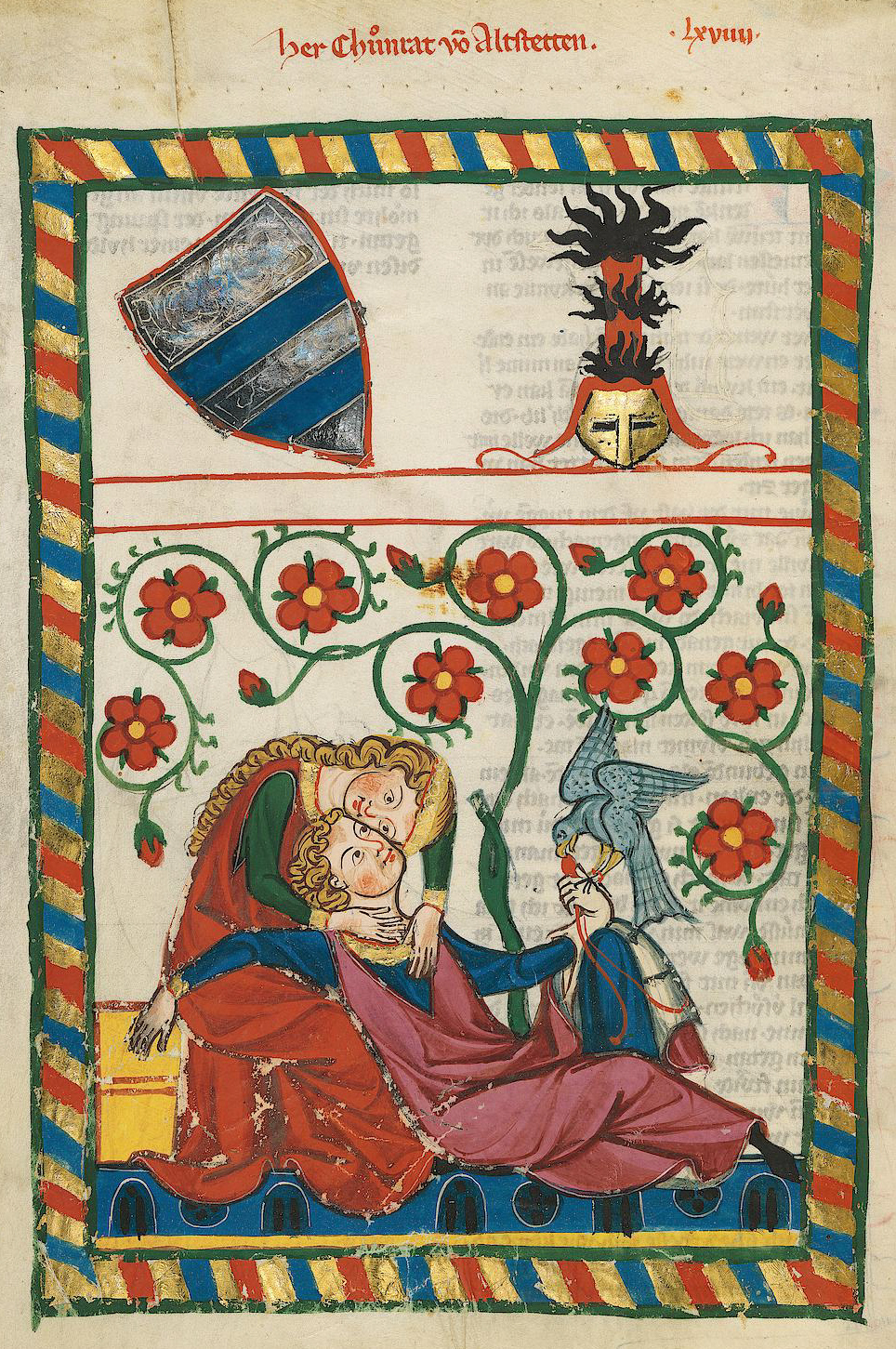
Das ärmellose Überkleid veränderte sich mit der Mode. Es wurde im 12. Jahrhundert zunächst körpernah getragen (wie bei meinem Kleid). Ab dem 13. Jahrhundert werden die Kleider weit und fliessend, so wie in diesem Bild aus dem Codex Manesse:

Für eine grosse Auflösung auf die Bildquellen
(weiter unten) klicken

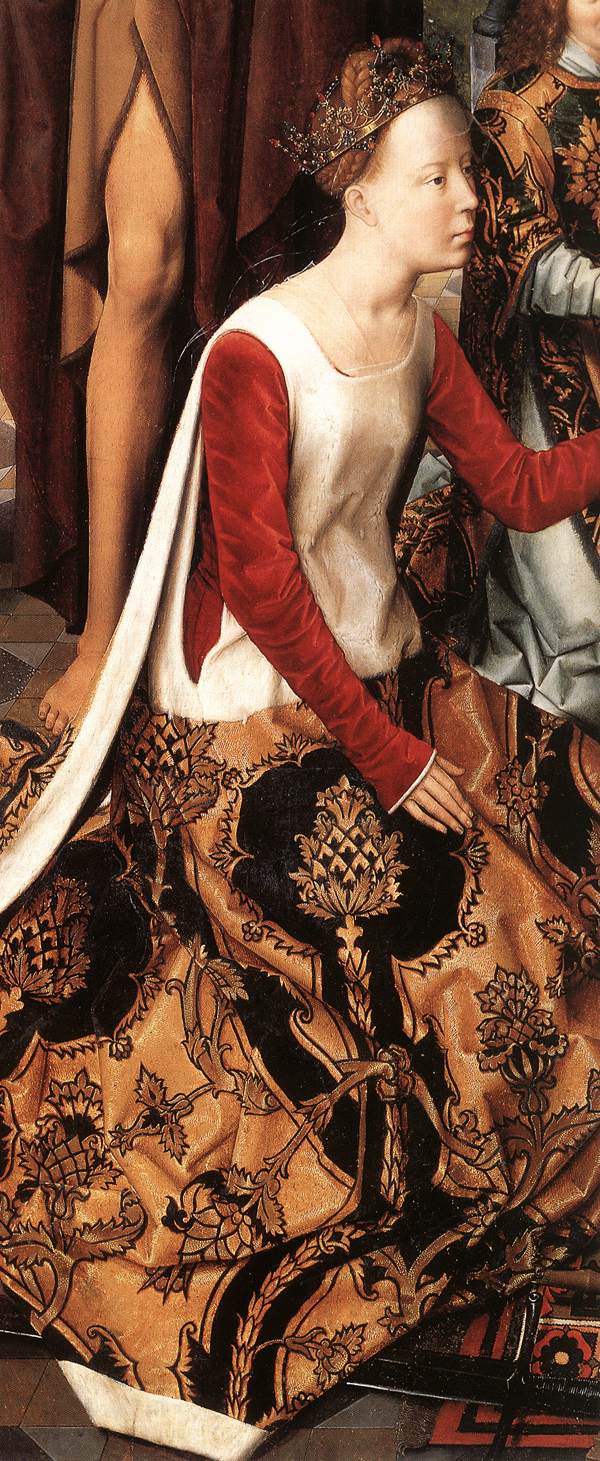
Danach wurden die Kleider wieder enger. Dazu kamen mancherorts tiefe Armlöcher, auch "Teufelsfenster"genannt, da sie Einblicke auf die Figur der Frauen unter dem Überkleid zuliessen.


Einen kompakten und hilfreichen Überblick über mittelalterliche Mode findet ihr übrigens hier:
http://www.gewandung.de/gewandung_entwicklung.shtml
Auf dieser Seite fand ich auch das Bild, das mir als Modell diente. Letztlich sollte es ein Kleid aus dem 12. Jahrhundert werden, wie die jeweils zweiten Figuren von links auf diesem Bild:


Das Kleid soll also etwa wadenlang sein, so dass man das Unterkleid gut erkennt, relativ eng anliegen und mit einer breiten Borte abgeschlossen werden. Sowohl weite wie auch enge Ärmel lassen sich damit gut kombinieren.

Bildquellen von oben nach unten:
Codex Manesse, ca. 1305
http://upload.wikimedia.org/wikipedia/commons/b/b6/Altstetten.jpg
Turin-Mailänder Stundenbuch, ca. 1420
http://upload.wikimedia.org/wikipedia/commons/5/50/Meister_%27G%27_des_Turin-Mailänder_Gebetbuches_001.jpg
Altarbild des hl. Johannes (Ausschnitt), Hans Memling, ca. 1475
http://www.lib-art.com/imgpainting/4/9/13794-st-john-altarpiece-hans-memling.jpg
Landgrafenpsalter, ca. 1210
http://digital.wlb-stuttgart.de/filegroups/psalnofeh_351035532/max/00000368.jpg


Das Kleid:


Das Kleid ist aus dünnem Wollstoff genäht. Es besteht im Wesentlichen aus Rechtecken und Dreiecken, wie hier beschrieben:
http://www.gewandung.de/gewandung_schnitt_prinzip.shtml
Die seitliche Schnürung ist eine Eigeninterpretation von mir, da mein Vorlagebild darüber keinen Aufschluss gibt. An diesem Punkt bin ich auch nicht ganz zufrieden, da das Kleid etwas enger ausgefallen ist als ich es mir vorgestellt hatte. Als nächstes werde ich eine breite Borte für den Saum anfertigen. Danach nähe ich ein neues Unterkleid. Aber davon dann zu einem späteren Zeitpunkt.

Alles Gute
Eta Carina


Hey there!
I finally got round to begin with something I wanted to do for quite some time: The overhaul of my medieval wardrobe. My medieval dresses don't live up to my expectations anymore. When I started sewing for medieval fairs, my motto was "this will do quite fine" and I think it did, more or less. But now I want to learn more about the history of fashion. I like to look at pictures of that period and imagine what the clothes depicted might have looked like in reality. Or maybe I'm just fed up with sweating in a cotton dress in summer… But I'm still free to make my own interpretations of what I see. Or as a friend of mine put it: "Your teeth will never look authentically medieval".
However, I work my way from the outside to the inside and began with what is most striking: The outer garment. I sewed a sleeveless overdress, which is also called "suckenie". Sleeveless dresses can be found during the whole medieval period and in all classes. So it's pretty easy, isn't it? Not quite...

Research:
The dress changed with the fashion. It was worn close-fitted in the 12th century (like the dress I made). From the 13th century on it was rather loose and flowing, like in the pictures of the Codex Manesse (first picture). After that clothes became more fitted again. They sometimes had deep armholes as well. Those armholes where called "devils windows", because you could clearly see the bodyshape of the women who wore them (pictures 2 and 3).
There's a short and helpful overview about medieval fashion on this site:
http://www.gewandung.de/gewandung_entwicklung.shtml

There I found the picture I used as a guideline for my dress. It's from the 12th century. I wanted my dress to look like the ones of the figures that are both second from the left (picture 4). It should end at the calves so the underlying dress would show well, be cut to the figure and end with a broad border. Both narrow and wide sleeves fit well with that dress.

Sources:
Picture 1: Codex Manesse, ca. 1305
http://upload.wikimedia.org/wikipedia/commons/b/b6/Altstetten.jpg
Picture 2: Turin-Mailänder Stundenbuch, ca. 1420
http://upload.wikimedia.org/wikipedia/commons/5/50/Meister_%27G%27_des_Turin-Mailänder_Gebetbuches_001.jpg
Picture 3: Altarbild des hl. Johannes (Ausschnitt), Hans Memling, ca. 1475
http://www.lib-art.com/imgpainting/4/9/13794-st-john-altarpiece-hans-memling.jpg
Picture 4: Landgrafenpsalter, ca. 1210
http://digital.wlb-stuttgart.de/filegroups/psalnofeh_351035532/max/00000368.jpg

The dress is made of thin wool. It is composed more or less of triangles and rectangles. I followed this description:
http://www.gewandung.de/gewandung_schnitt_prinzip.shtml

The lacing on the side is my own interpretation. It is a little bit too tight for my taste. But all in all I'm content. Next I'll make the border. After that I'll sew a new underdress. But I will tell you more about this in another post.

All the best
Eta Carina